In short: Skip the registry's safe picks and the sentimental clutter. The gift that clears both tastes is one that serves the room they share, a single item with a clear job, chosen for the space, not for one person. This guide organizes every pick around that shared-space test, so you can give something both halves actually use.
We write buying guides, not product reviews. We have not used every item on this page, and specs come from the manufacturer or listing. Whatever Amazon shows when you click is the authoritative figure on price, availability, and ratings.
This article contains affiliate links. If you buy through one, we earn a small commission at no extra cost to you. We only recommend what we would suggest to a friend.
The Federal Trade Commission's endorsement guides, 16 CFR Part 255, require a disclosure like that one to be difficult to miss, so it sits above every link here. Our full affiliate disclosure has the rest.
You are standing outside the relationship. You know one of them well, the other barely, and you have never seen their cupboards. A wedding gift has to satisfy two people and then live in a home you cannot picture. That is a different problem from buying for one. That is why our pillar guide, Gifts for Couples That Work for Two Different People, treats the two-taste problem as the core challenge.
Helzberg Diamonds reported in 2022 that the average wedding cost was $33,204. Your gift does not need to compete with that figure. It needs to be useful in the home they return to after the day itself.
The shared-space test for wedding gifts
A wedding gift is a household gift. It has to clear two different tastes and land somewhere in a home you have never seen.
Three lanes survive that test. A shared experience, with the logistics stated. A shared consumable, something they will finish. Or the good version of an object both of them touch every day.
The test is simple. Does this item serve the room they share, or does it serve one person's hobby, one person's taste, one person's nostalgia? If it serves one person, it is not a couple's gift. It is a gift for one of them with a wedding card attached.
This is why personalized keepsakes fail the test. A monogrammed cutting board where one of them cooks and the other does not is a gift for the cook. A star map of the wedding date is a gift for the wall, and walls do not use things.
The same logic kills matching sets for each half. Two robes, two flasks, two matching anything is two gifts for two individuals. The couple already has two individuals. What they are building is one shared space, and the gift should serve it.
Decor that earns its spot in the room they share
Decor is the hardest category. Most decor is someone's taste sitting in someone else's room.
The decor that clears both tastes is functional. Lighting, because both of them read and both walk through the room. Storage, because both generate clutter. Wall art, only when neutral enough that neither half objects.
Skip the sentimental version. A framed print of their first dance song is a gift for one half's nostalgia. A well-made floor lamp with a dimmer, for the room they share, gets used every evening by both of them. It does not require either to like the same art.
Textiles work the same way. A throw blanket in a neutral color serves the couch they share. A weighted blanket serves the bed they share. Both get touched, washed, and replaced. Decor that earns its spot is decor that gets used, not decor that gets admired once and then dusted.
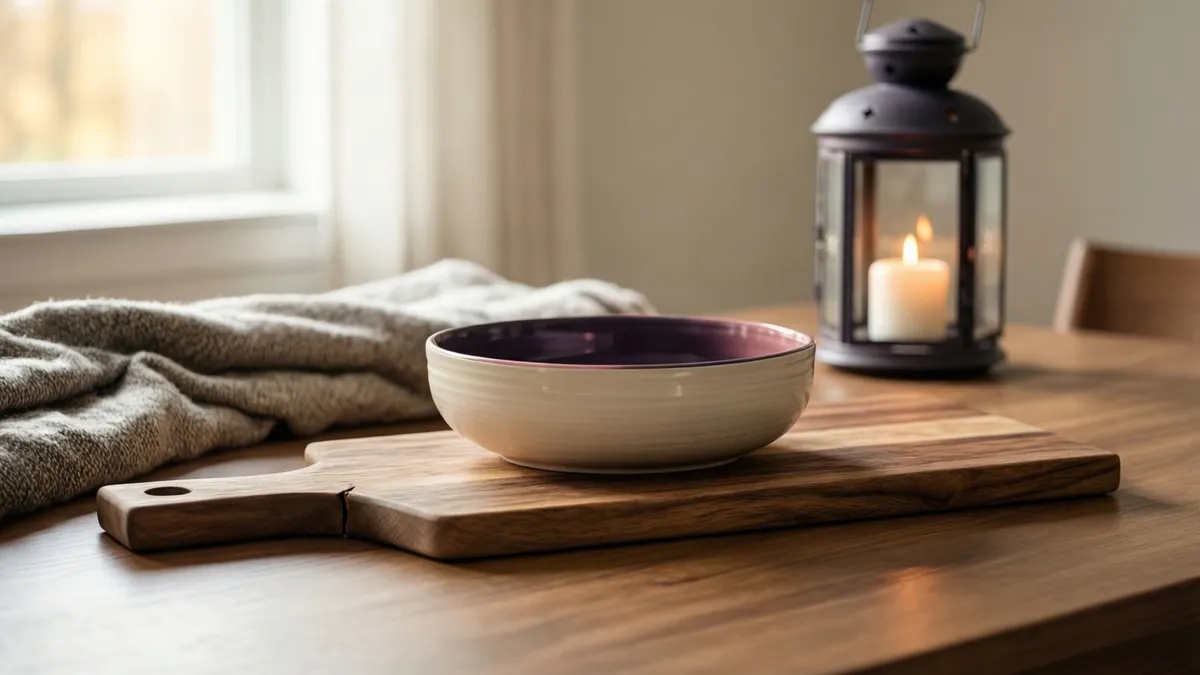
Candles are the edge case. They are consumable, which helps. They are also strongly scented, which means one half may love the smell and the other may hate it. Pick a low-scent option, or a candle warmer lantern that lets them control the intensity. That serves the room better than a fragrance imposed on it.
Serveware and glassware with a real job
Tableware is the classic wedding gift because it is genuinely shared. Both of them eat. Both drink. Both set the table.
The mistake is buying display-only pieces. Crystal decanters that sit on a shelf. Champagne flutes that come out once a year. These are objects the couple admires, not objects they use.
A large wooden serving board, for the table they share, gets used every time they host. A set of everyday wine glasses gets used weekly if either drinks wine with dinner. These are the pieces that earn their cabinet space.
Serveware with a job is the sweet spot. A ceramic serving bowl big enough for a salad feeds both of them and any guests. Neither is display-only. Neither is one person's taste.
The registry usually covers everyday plates and flatware. What it misses is the serving layer, the pieces that make hosting easier. That gap is where a tableware gift lands best.
Kitchen tools that outlast the registry
Kitchen gear is where durability matters most. A cheap gadget breaks. A good tool lasts decades.
Buy one workhorse, not a basket of single-use gadgets. A 6-quart enameled Dutch oven, for the kitchen they share, is the single most useful pot in most homes. It braises, bakes bread, goes on the stovetop and in the oven, and serves at the table. Both halves will use it whether they cook daily or weekly.
A good chef's knife, for the two of them, is the other workhorse. If the registry has a knife set, check whether it includes a proper forged 8-inch blade. If it does, skip this. If it does not, a single good knife beats a block of mediocre ones.
The registry usually covers cookware sets and small appliances. What it often misses is the one exceptional piece, the Dutch oven that outlives the nonstick pans, the knife that replaces the dull one in the block. That is the gap to fill.
Avoid novelty kitchen tools. An avocado slicer, an egg separator, a banana-shaped knife. These are gifts for a laugh, not gifts for a kitchen, and they take up drawer space the couple will resent.
Experiences with the logistics stated first
An experience is a logistics gift. Check the booking window, the expiry date, how far it is, and whether both of them can be free on the same day.
A cooking class works if both cook, or want to. A wine tasting works if both drink wine. A weekend away works if both can take the same days off. The experience has to be something the two of them do together, not something one does while the other watches.
Mintel found in 2017 that 76% of adults who had attended a wedding celebration in the previous three years agreed cash or gift vouchers were an ideal wedding gift. That tells you what guests think recipients want. It does not change the fact that a well-chosen experience, with logistics handled, gives the couple something they would not book for themselves.
The booking details are the gift. Include the date range, the location, the expiry, and whether they need to reserve. A voucher with no instructions is a chore. A voucher with a suggested date and a printed itinerary is a gift.
Travel gear works the same way. A picnic backpack for the two of them turns a nearby park into a planned evening. It serves the shared space because it creates one.
Off-registry wedding gifts that still pass the test
Going off-registry is defensible when the registry is picked clean, when you know something specific that no list captures, or when the gift is consumable. It is indefensible when it is just a bigger version of something already on the list.
Check the registry first. If it has a Dutch oven, do not buy a different one. If it has wine glasses, do not buy better ones. The registry exists to stop four guests buying the same thing, and that mechanism only works if you respect it.
If the registry is empty, thin, or exhausted, the shared-space test still applies. A coffee subscription, for the two of them, is a consumable both halves drink. A premium olive oil set, for the kitchen they share, is a consumable both cook with. These pass because they get used up, not stored.
For couples who already live together and have an established home, the registry may reflect what they already own. Their home does not need another object. Their evenings could use a planned night out.
Our suggested off-registry decision checklist:
- Is the registry checked? If no, stop and check it.
- Is the item already on the registry in a different form? If yes, skip it.
- Does the item serve the room they share, not one person? If no, skip it.
- Is it consumable or durable? Either is fine. Display-only is not.
- Can both halves use it without one adapting to the other's taste? If no, skip it.
- Do you know something specific about their home the registry misses? If yes, this is your opening.
For more on the mechanics of when to go off-registry, our guide on Registry Picked Clean? What to Buy Off-Registry walks through the decision in detail. For a broader take on household-gift logic, Useful Gifts for Couples: The Household-Gift Test covers the same test across occasions.
A handwritten note matters here. Keep it short: name both of them, state what you hope the gift does for their home, and sign it. The card is not the gift, but a card with no specific reference to the couple reads like a form letter.
What you're actually paying for: price versus durability
Price bands below are ours, not a sourced figure. They reflect what we would expect to pay for a quality version of each item, based on general market awareness, not a specific listing.
| Category | Example pick | Price band (our judgment) | Expected lifespan | Shared-use fit | Clears both tastes? |
|---|---|---|---|---|---|
| Decor | Dimmable floor lamp | $75 to $150 | 5 to 10 years | Daily, both halves | Yes |
| Tableware | Large wooden serving board | $50 to $120 | 5 to 15 years | Weekly, both halves | Yes |
| Kitchen | 6-quart enameled Dutch oven | $75 to $200 | 10+ years | Weekly, both halves | Yes |
| Experience | Cooking class for two | $100 to $250 | One evening | Single use, both attend | Yes, if logistics work |
| Consumable | Coffee subscription (3 months) | $45 to $90 | Used up | Daily, both halves | Yes |
| Keepsake | Monogrammed frame | $30 to $60 | Indefinite | Rarely touched | No |
The table is the whole argument in one grid. Items that clear both tastes have daily or weekly shared use and a finite or long lifespan. The item that fails sits indefinitely and gets touched rarely.
Our take: If you can only pick one category, go kitchen. A Dutch oven or a good knife is the gift most likely to be used weekly by both halves and to outlast every other wedding gift. They will never be duplicated because most registries skip the exceptional single piece. The trade-off is price, but a group gift pooling two or three guests solves that. For a smaller budget, a serving board or a consumable subscription clears the same test at half the cost.
Do I still need to buy a wedding gift if I'm in the wedding party?
Wedding party members typically spend more than other guests, not less, because attire and travel costs are separate from the gift itself. A wedding gift is still expected even after those expenses, but it can be smaller or group-pooled. The shared-space test still applies.
The couple said no gifts. Should I bring one anyway?
Respect the request. A no-gift note is usually deliberate, not a test of generosity. If you cannot attend empty-handed, a handwritten card or a small consumable given privately, like a bottle of wine, is the one exception. Do not bring a wrapped object to the reception.
Is it okay to give both a registry gift and a personal gift?
Yes, but keep the personal gift small and consumable. A registry item plus a bottle of wine or a box of chocolates works well. A registry item plus a large off-registry object creates a comparison that makes one gift feel like a warm-up.
How much should a plus-one contribute to a group wedding gift?
A plus-one should match what they would spend individually, which depends on how well they know the couple. If they know one half well, the same range as a solo guest applies. If they barely know either, a smaller contribution is fine, and the primary guest can make up the difference.
What's a good wedding gift for an older couple with an established home?
Skip household objects. They already have the Dutch oven, the knife, the serving board. An experience they would not book for themselves, or a premium consumable they use daily but would not splurge on, is the route. Their home is full. Their schedule is the gap.
Are bridal shower gifts and wedding gifts separate expectations?
Yes. A shower gift is typically smaller and often themed toward the home or the kitchen, while the wedding gift is the larger contribution. If you are invited to both, budget for two gifts, not one split across occasions. The shower gift can be a consumable or a smaller household item.
Mara Ellison writes buying guides, not reviews; nothing here was tested by us.
Sources
- Mintel — "Big fat wedding bill: The average wedding guest spends over £100 on an outfit and more than £70 on a gift" (https://www.mintel.com/press-centre/big-fat-wedding-bill-the-average-wedding-guest-spends-over-100-on-an-outfit-and-more-than-70-on-a-gift) "Retrieved 2026-08-23".
- Federal Trade Commission — "Guides Concerning the Use of Endorsements and Testimonials in Advertising" (https://www.ftc.gov/legal-library/browse/federal-register-notices/guides-concerning-use-endorsements-testimonials-advertising) "Retrieved 2026-08-23".