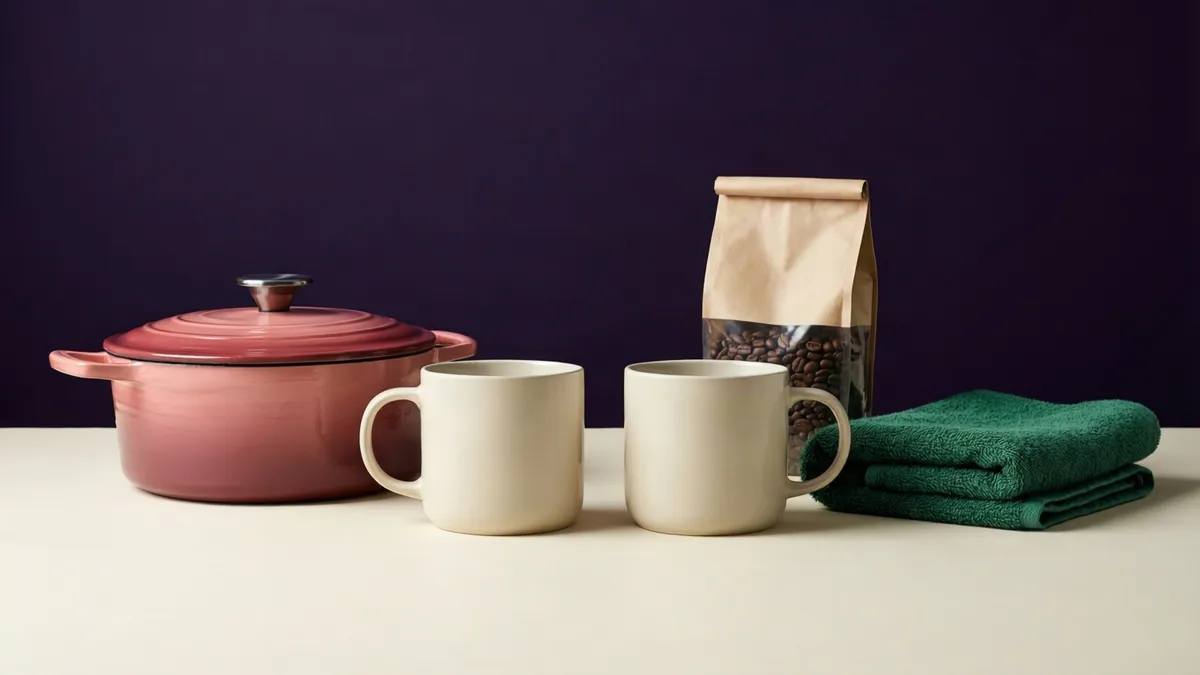
In short: The best gift for a couple is one that can't be split into two single-person gifts. It either requires both of them to use it, or it's a shared resource for the home they co-manage. If one half can use it alone without the other noticing, it's not a couples gift. It's two gifts in a box. This guide sorts the best pair-led picks by how they force the two of them to share.
We write buying guides, not lab reviews: nothing on this page has been tested by us in anybody's home. Prices, availability and ratings change constantly — whatever Amazon shows when you click is the authoritative figure.
This article contains affiliate links. If you buy through one, we earn a small commission at no extra cost to you. We only recommend what we would suggest to a friend.
The Federal Trade Commission's endorsement guides, 16 CFR Part 255, require a disclosure like that one to be difficult to miss, so it sits above every link here. Our full affiliate disclosure has the rest.
A gift for a couple is a gift for a household. It has to clear two different tastes and land in a home you have never seen. For a wider lens on the same problem, see Gifts for Couples That Work for Two Different People.
The rule on this page is narrow. A couples gift must be unusable by one half alone, or it must be a shared home resource. Everything below pays into that test.
The test: can one of them use it alone?
This is the whole filter. Before you buy anything, ask: can one of them open this, use it, and finish it without the other person being in the room?
If yes, it's not a couples gift. It's a single-person gift with a second name on the tag.
The rule matters because couples gifts fail most often at this exact point. Two robes in a box. A mug set. A bracelet. Each half gets one, each half uses one alone, and the gift never forces the pair together. The National Retail Federation's 2026 survey found that 83% of consumers celebrating Valentine's Day plan to purchase a gift for a significant other. Most of those gifts are individual objects, not shared ones.
Two passes exist. First, does the object require two people to operate? A two-player game, a build kit, a cocktail set that needs one person to shake and one to pour. Second, if it doesn't require two hands, is it a resource for the home they share? A coffee maker, a mattress topper, a sound system. Either pass works. Neither is negotiable.
For the two of them: games, kits, and projects that need both
This is the purest category. A two-player board game cannot be played alone. A build kit needs one person to hold and one to fasten. A cocktail kit with a shaker, a jigger, and a recipe book is a project for two people on a Friday night.
Board games are the strongest pick here. Look for games rated for exactly two players, not games that "can be played with two." The difference matters: a game designed for two forces both people to engage every turn. A game that accommodates two lets one person carry the strategy while the other watches. Two-player board games are the safest search if you don't know their shelf.
Cocktail kits work the same way. One person measures, one shakes, both drink. A home cocktail kit gives them a reason to be in the kitchen together, and the result is consumable. It finishes. That's the double win: pair-led and temporary, so it doesn't need a shelf.
Build kits force cooperation the same way. Model sets, furniture kits, even a pizza stone with a dough kit put both people in the same task. One reads instructions, one assembles. The finished object is secondary. The process is the gift.
For couples who already have everything, the consumable angle is the one that breaks through. Our Gifts for Couples Who Have Everything: Go Consumable expands on why finishing beats keeping.
Home upgrades that only make sense as one unit
A household gift serves the room, not either person. The test: if one of them moved out, would the object stay?
A coffee maker stays. A mattress topper stays. A robot vacuum stays. These are shared infrastructure. Both people use them daily, neither one owns them, and the home needs them regardless of who lives in it.
A better coffee maker is the archetype. Both people touch it every morning. Upgrading from a drip machine to a quality burr grinder and brewer changes the household's daily rhythm. The gift is for the kitchen, not the cup.
Candles are a borderline case. They serve the room, since both people smell them, but they're deeply personal to taste. Safety standards matter too. The U.S. Consumer Product Safety Commission's 2021 standard, ASTM F2058-07(2021), governs candle fire safety labeling. ASTM F2417-17, also referenced by the CPSC, sets fire safety requirements for candles themselves. A candle passes the pair test only if both people would choose to burn it. If one loves the scent and the other opens a window, it's a single-person gift with wicks.
For the broader household-gift logic, Useful Gifts for Couples: The Household-Gift Test walks through the same filter from the practical side.
Experiences with a double booking
An experience is a logistics gift. Check the booking window, the expiry date, how far it is, and whether both of them can be free on the same day.
The pair test for experiences is stricter than for objects. A cooking class for two passes. A spa voucher for one person fails. One half gets pampered, the other drives home. A food tour or wine tasting passes only if the voucher covers two admissions.
Gift cards and vouchers carry their own mechanics. Federal rules that took effect in 2010 restrict gift card fees and expiration dates, per the Federal Trade Commission. Those rules cover minimums under the CARD Act. Some experience vouchers impose tighter windows than that. Read the terms before you buy, not after.
The National Retail Federation reported in 2026 that Valentine's Day spending is expected to reach a record $29.1 billion. Spending on gifts for romantic partners alone is expected to hit $14.5 billion. Shoppers are budgeting an average of $199.78. That average covers all gifts, not just experiences. But it tells you where the bar sits if you want your gift to register.
For engagement-specific experience gifts, Engagement Gifts for Couples That Do Not Jump Ahead covers what to give before the wedding. In this case, the pair test still applies but the timeline is shorter.
When a personalized gift is actually a couples gift
Personalization is where most couples gifts fail the test. A monogrammed robe for one person is a robe. A set of engraved glasses is two glasses. The personalization has to reference the pair, not either individual.
Custom art of their shared home passes. A map of where they met passes. A photo book of their trips together passes. Each one is a single object that only makes sense because both people are in it.
The test: if you removed one person's name or face, would the object still work? If yes, the personalization is decorative, not structural. A custom house portrait only makes sense because both of them live there. Remove either person and the house is still the house, but the gift's meaning collapses.
Spending on jewelry for Valentine's Day is expected to reach $7 billion in 2026, according to the NRF's same survey. Engraved jewelry is popular, but a bracelet with one person's name is for that person. Matching rings pass the test only if both people wear them. Even then, the gift is really two gifts in a shared box.
For wedding-specific personalized gifts, Wedding Gifts for Couples: Clear Both Tastes covers the registry-adjacent picks where personalization meets household utility.
The comparison: pair-led vs. single-use at the same price
Price bands below are ours, not a sourced figure. The verdict column applies the pair test from this guide's thesis.
| Gift | Price band | Who it serves | How it forces pair use | Pair test |
|---|---|---|---|---|
| Two-player board game | under $50 | both | Requires two players every turn | Pass |
| Cocktail kit | under $50 | both | One measures, one shakes, both drink | Pass |
| Custom house portrait | $50 to $150 | the room they share | References a home both occupy | Pass |
| Coffee maker upgrade | $150+ | the room they share | Shared daily infrastructure | Pass |
| Cooking class for two | $150+ | both | Two admissions, one booking | Pass |
| His-and-hers robe set | $75 to $150 | one each | Each half uses one robe alone | Fail |
| Engraved bracelet | $50 to $150 | one | One person wears it | Fail |
| Smart mug | under $50 | one | Keeps one person's drink warm | Fail |
Our take: The board game and the cocktail kit are the safest picks under $50 because they structurally require two people and they finish. No shelf needed. Above $150, the coffee maker wins over the cooking class if you don't know their schedule, because shared infrastructure doesn't expire. Skip the robe set and the smart mug: both are single-person gifts dressed as couples gifts, and the smart mug in particular is tech for one.
What to skip: gifts that are really for one of them
The clearest failures are tech and matched sets.
A smart mug keeps one person's coffee warm. Per the Specialty Coffee Association (2022), the Ember Mug² Copper Edition maintains a chosen temperature between 120°F and 145°F for up to 1.5 hours on its built-in battery. That's a genuine feature, for one person. The other half doesn't notice. It fails the pair test completely.
Matched sets fail differently. "His and hers" robes, towels, or pillows are two single gifts in shared packaging. Each half uses one. The pair never interacts. The gift is a matching aesthetic, not a shared experience.
One-sided hobbies are subtler. A golf accessory for one half, a knitting kit for the other, wrapped together and presented as a pair. Each person gets a solo gift. The couple gets nothing shared.
Candy is the most popular Valentine's Day gift, with 56% of consumers planning to purchase candy, per the NRF's 2026 survey. Candy passes the pair test only if it's a shared box both people open. Not two separate bars. A box of artisan chocolates for the coffee table passes. Two individually wrapped bars, one per person, fail.
What to buy instead? If you were going to spend $75 on a robe set, spend $75 on a board game and a bottle of something. If you were going to spend $150 on a smart mug, spend it on a cocktail kit and a shaker. Redirect the budget toward the pair.
The rule in practice: a checklist before you buy
Run any candidate through these five questions before checkout:
- Can one of them use it alone, without the other person being present? If yes, stop.
- Does it require two people to operate, whether two players, two hands, or two admissions? If yes, buy.
- Is it a shared home resource that stays if either person moves out? If yes, buy.
- Does the personalization reference both of them, or just one? If one, it's a solo gift.
- Is it consumable? If yes, it won't need a shelf, and shared consumables are the lowest-risk pair gift.
This checklist is ours, not a sourced framework. It's the thesis applied as a filter you can copy.
The U.S. Census Bureau reported in 2025 that 47% of U.S. households were married-couple households, down from 66% in 1975. That shift means more couples are cohabiting without marriage, and the gift rule doesn't change. The pair test applies whether the couple is dating, engaged, or twenty years in. The home they share is the constant.
For registry-adjacent decisions, Registry Picked Clean? What to Buy Off-Registry covers the mechanics of going off-list without duplicating.
What is a good price range for a couples gift?
$50 to $150 is the sweet spot. Enough to buy the good version of a shared object without crossing into overspending. Under $50 works for consumables and games. Above $150, buy shared infrastructure like a coffee maker or a cooking class for two, not a more expensive version of the same thing.
Which couples gifts get returned most often?
Matched sets and single-person tech carry a high risk of being returned, as one person often does not use their portion of the gift. Personalized items are non-returnable by design. Many custom shops state a no-return policy on engraved or illustrated work. Buy personalized only when you're certain of the address, the spelling, or the reference.
Is it better to give an experience or a physical gift to a couple I don't know well?
A physical shared object is safer when you don't know their schedule. Experiences require both people to be free on the same day, and you can't know that from outside the relationship. If you do give an experience, make sure the voucher covers two admissions and check the expiry window before buying, not after.
Do the same gifts work for newlyweds and couples who have been together 20 years?
The pair test doesn't change with relationship stage, but the category shifts. Newlyweds are often building a household from scratch, so shared infrastructure fills a real gap. Couples together longer already have the infrastructure, so consumables and experiences are the better lane.
What if the couple has completely different interests?
Buy for the overlap, not for each person separately. A couple where one loves the outdoors and one loves gaming still shares a home, a kitchen, and a table. A cocktail kit or a shared cooking class serves neither person's hobby but serves the pair. That's the point.
How do I compare a subscription vs. a one-time experience vs. a physical keepsake?
Subscriptions repeat, so they extend the pair test over time. A coffee subscription serves both people every month. A one-time experience is intense but finite. A physical keepsake lasts longest but fails the pair test unless it references both people. When in doubt, the subscription is the most pair-led: both consume it, and it doesn't need a shelf.
Mara Ellison writes buying guides, not reviews; nothing here was tested by us.
Sources
- National Retail Federation — "Valentine's Day Spending Expected to Reach New Records" (https://nrf.com/media-center/press-releases/valentine-s-day-spending-expected-to-reach-new-records) Retrieved 2026-08-24.
- U.S. Census Bureau — "Census Bureau Releases New Estimates on America's Families and Living Arrangements" (https://www.census.gov/newsroom/press-releases/2025/families-and-living-arrangements.html) Retrieved 2026-08-24.
- Federal Trade Commission — "Gift Cards" (https://www.ftc.gov/news-events/topics/truth-advertising/gift-cards) Retrieved 2026-08-24.
- U.S. Consumer Product Safety Commission — "Candles and Candle Accessories" (https://www.cpsc.gov/Regulations-Laws--Standards/Voluntary-Standards/Candles-and-Candle-Accessories) Retrieved 2026-08-24.
- Specialty Coffee Association — "Ember Mug² | Copper Edition, 14 oz" (https://new.sca.coffee/entries/ember-mug-copper-addition) Retrieved 2026-08-24.
- Federal Trade Commission — "Guides Concerning the Use of Endorsements and Testimonials in Advertising" (https://www.ftc.gov/legal-library/browse/federal-register-notices/guides-concerning-use-endorsements-testimonials-advertising) Retrieved 2026-08-24.