In short: A useful gift for couples passes the Household-Gift Test. It serves both of them, cuts a recurring chore, or earns a permanent spot in a room they share. Gifts that only one half will use, store, or maintain fail the test, no matter how practical they look. This guide applies the test to common picks, labels each by the half it serves, and ends with a pass/fail table for the most popular categories.
We write buying guides, not lab reviews: nothing on this page has been tested by us in anybody's home. Specifications come from the manufacturer or listing, and whatever Amazon shows when you click is the authoritative figure.
This article contains affiliate links. If you buy through one, we earn a small commission at no extra cost to you. We only recommend what we would suggest to a friend.
The Federal Trade Commission's endorsement guides, 16 CFR Part 255, require a disclosure like that one to be difficult to miss, so it sits above every link here. Our full affiliate disclosure has the rest.
A gift for a couple is a gift for a household. It has to clear two different tastes and land in a home you have never seen. This is why the reliable answers are a shared experience, something they will finish, or the good version of an object they already touch every day. The broader framework lives in our pillar, Gifts for Couples That Work for Two Different People. This page narrows to one question: is the gift actually useful, or does it just look useful?
The difference matters. A practical-looking gift that serves one half becomes the other half's clutter. The Centers for Disease Control and Prevention's National Center for Health Statistics reported a U.S. marriage rate of 6.1 per 1,000 total population in 2023. That rate means the wedding-gift season is not a season. It runs year-round, and most of those gifts are bought by someone who knows one half well and the other barely.
The Household-Gift Test: what a useful couple gift actually does
Three questions settle it. Does it serve both of them? Does it cut a recurring chore? Does it have a permanent home in a room they share? A gift that answers yes to at least one passes. A gift that answers no to all three is for one person with a second name attached.
"Useful" is where most guides go wrong. A single-serve blender is useful. A monogrammed cutting board is useful. But useful to whom, and where does it live? A tool that one half operates and the other half cleans is not a couple's gift. It is one person's hobby equipment stored in shared space.
The test catches this. A cast-iron skillet serves both of them if both cook. A personalized cutting board serves both of them if both use it for prep or hosting. A single-serve blender serves one of them, and the other half washes it.
Practical gifts fail when they become one person's project. A herb garden kit that one half waters and the other ignores is not shared. An espresso machine that one half operates and the other descales is a solo purchase with a shared counter footprint. The test asks whether the gift reduces work for both or adds work for one.
Here is our suggested version of the test, as a checklist you can copy and run on anything before you buy:
- Does it serve both of them? Both people should use it, eat it, or attend it, not just one.
- Does it cut a recurring chore? It should remove a task, not create a new one for either half.
- Does it have a home? It should earn a permanent spot in a room they share, not a shelf in one person's office.
- Who maintains it? If one half cleans, stores, or updates it, the gift is for that half.
- Will they finish it? Consumables and experiences pass by definition; they cannot become clutter.
- Does it duplicate a registry item? If the couple already registered for it, buy from the list, not next to it.
Kitchen gifts that pass the test: one tool, two cooks
The kitchen is where the Household-Gift Test is easiest to pass. Both people eat. Both people cook, or at least both plate. A tool that sits at the center of the kitchen serves the room they share, not one person's hobby.
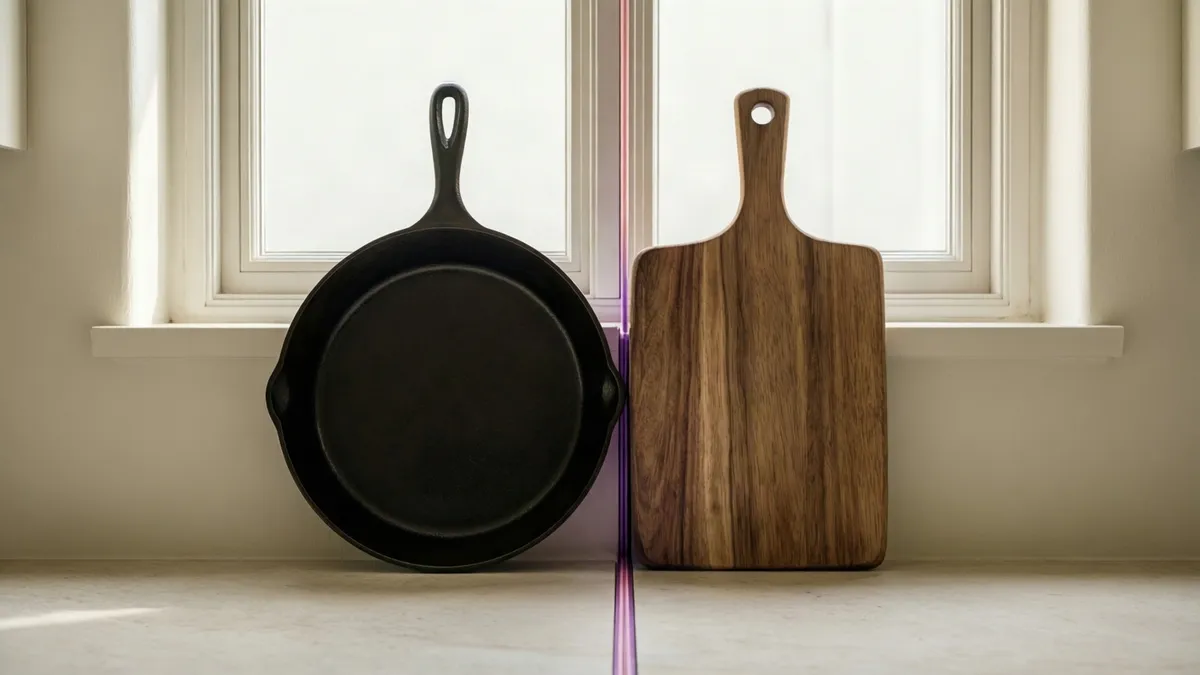
A cast-iron skillet is the canonical pass. It serves both of them because both eat from it. It cuts a chore because it replaces a thinner pan that warps and scorches. Per the manufacturer, it is oven-safe and compatible with all heat sources, which means it works regardless of their kitchen setup. It earns a permanent spot on the stovetop or the counter, and it lasts long enough to outlive the registry.
A large cutting board with a juice groove passes for the same reason. Both people use it for prep. It lives on the counter. If you personalize it, the personalization works only when both of them reach for it. A board engraved with their names that sits in a cabinet is a keepsake, not a tool.
A serving board passes for couples who host. It serves the room they share when guests are over. It cuts the chore of plating food individually. It earns a permanent spot because it replaces paper plates and plastic trays. The test question is whether they entertain at all. If they do not host, a serving board is furniture.
Kitchen gifts fail when they are single-operator tools. An espresso machine serves one of them if only one half pulls shots. A sous vide circulator serves one of them if only one half cooks sous vide. A pasta maker serves one of them unless both are in the kitchen rolling dough. The test is not whether the tool is useful. It is whether both hands touch it.
A cooking class passes if both attend. Check the booking window, the location, and whether both of them can be free on the same night. A class only one half can attend is a gift for that half, not for the couple.
Cozy home gifts that earn their corner
Cozy gifts are the trickiest category. They look shared and often are not. A throw blanket draped on one half's reading chair serves one of them. A king-size blanket on the bed they share serves both.
The test draws the line at the room, not the object. A king-size weighted blanket for the bed they share passes because both people sleep under it. A single throw for the couch fails if one half claims it and the other never touches it. Per the manufacturer, the weight is stated in pounds, which matters: a blanket too heavy for one half defeats the purpose.
Sheets pass the test. Both people sleep on them. A set in a neutral color clears two different tastes because neither half picks a color the other hates. The listing states the thread count, but the real question is whether both of them will make the bed with them.
Robes fail more often than they pass. A matching set of robes looks like a couple's gift, but each robe serves one person. One half may wear theirs daily. The other may never open the box. If you buy robes, buy one good one for the half you know, not a pair for a couple.
Pillows are personal. A body pillow for the bed passes if both use it. A decorative throw pillow for the couch is staging, not a gift. It serves the room's appearance, not the people in it.
The CDC's National Center for Health Statistics reported 672,502 divorces in 2023 across 45 reporting states and D.C., a rate of 2.4 per 1,000 population. The point is not cynicism. A gift for the room they share works whether the household stays intact or restructures, because both people used it daily. A monogrammed pillow with both names does not.
Date night gifts that get played, not shelved
Date night gifts are the category most likely to be opened once and shelved. A deck of conversation cards. A scratch-off poster of date ideas. A board game that neither half asked for. The test asks whether the gift has a recurring use or a booked date.
A conversation deck fails if it is opened once on a couch and never touched again. It passes if the couple plays it weekly, which means the cards need enough depth to return to. The listing states the number of cards and the prompt categories, which tells you whether the deck has enough variety for repeat use. A deck with fifty cards and vague prompts will run dry quickly.
A two-player board game passes if it fits their habits. Do they already play games together? If they do, a game that fits their shelf and their skill level is a strong gift. If they do not, you are introducing a hobby, not giving a tool. Ask whether the game has a learning curve both of them will clear, or whether one half will learn it and the other will tolerate it.
Experience gifts pass the test by definition because they cannot become clutter. But they carry logistics. Check the booking window, the expiry date, the distance from their home, and whether both of them can be free on the same day. An experience voucher that expires before they use it is a wasted gift, not a memory.
A restaurant gift card they both like passes if it covers a full meal for two. It cuts the chore of deciding where to eat. It has a home in their wallet. It will be finished. The test is whether the restaurant suits both of their tastes, not just the half you know.
Useful gifts that divide a chore instead of adding one
Chore-dividing gifts are the highest-value category under the Household-Gift Test. They serve both of them by removing a task neither wants. They cut a recurring chore by definition. They earn a permanent place because they replace a worse version of something already in the home.
A robot vacuum is the strongest pick in this lane. It serves both of them because both walk on the floor. It cuts a chore that neither half enjoys. Per the manufacturer, the run time and bin capacity are stated in the specs, which tells you whether it can cover a specific square footage without mid-cycle emptying. The test question is whether their floor plan has clear paths. A robot vacuum in a cluttered apartment adds work, not removes it.
A meal kit subscription passes if both of them eat the meals. It cuts the chore of planning, shopping, and deciding. It will be finished. The test: does it reduce arguments about dinner, or does it create a new obligation to cook meals neither half wants? If one half cooks and the other eats, the kit serves the cook as a chore, not a gift.
A laundry sorter passes for the same reason. Both people generate laundry. A three-bin sorter removes the sorting step on wash day. It earns a permanent spot in the closet or laundry room. The test: does it fit their space? A sorter too wide for their closet is furniture, not a tool.
The Internal Revenue Service reported that the 2026 annual gift tax exclusion is $19,000 per donee, and two spouses can give a combined $38,000 per donee. Most couple gifts will never approach that threshold. But if you are splitting a large gift with a spouse, the exclusion settles whether your shared purchase triggers a filing requirement.
Chore gifts fail when they become one person's new job. A robot vacuum that one half empties and the other ignores is a chore for the half who empties it. A meal kit that one half cooks and the other eats is a grocery delivery, not a shared activity. The test asks whether the gift removes work from both or shifts it.
Putting popular categories to the Household-Gift Test
The table below runs the test on six categories that dominate couple-gift guides. The listing-claim column reflects what product pages typically promise. The pass/fail and reasoning columns are our editorial judgment, not a sourced figure.
| Category | What listings typically claim | The test question it must answer | Pass or fail | Why |
|---|---|---|---|---|
| Personalized keepsakes | "A unique gift they'll treasure forever" | Will both of them use it, or will it sit on a shelf? | Conditional | Passes for milestones if both value it; fails as a daily object |
| Kitchen tools | "The perfect gift for the home chef" | Do both cook, or does one cook and the other clean? | Pass | Both people eat; a shared tool serves the room |
| Cozy textiles | "Keep them warm and cozy all season" | Does it go on the bed they share, or one person's chair? | Conditional | King-size bed items pass; single throws fail |
| Date-night cards | "Reconnect and spark meaningful conversations" | Will they play it more than once, or open it and shelve it? | Fail | Most decks are opened once; lacks recurring use |
| Board games | "Fun for game night and couples' gatherings" | Do they already play games, or are you introducing a hobby? | Conditional | Passes for established game-night couples only |
| Photo and memory gifts | "Celebrate your favorite moments together" | Does it replace clutter, or add to it? | Conditional | Digital frames pass; physical prints and albums add objects |
Our take: Kitchen tools and shared bed textiles are the safest useful gifts for couples because both people use them daily without being asked to change their routine. Date-night cards and decorative keepsakes fail more often than they pass because they depend on the couple adopting a new habit. When in doubt, buy the good version of something they already touch every day, or buy something they will finish.
For couples who don't want more stuff: experiences, consumables, and one-box rules
Some couples have enough objects. They live in a small apartment, or they are minimalists, or their hobbies diverge so widely you cannot find the overlap. For them, the one-box rule applies: if it does not fit in one box or one calendar slot, skip it.
A coffee subscription passes. Both people drink coffee. It arrives, gets consumed, and disappears. It cuts the chore of buying coffee and leaves no permanent footprint. The test is whether both of them drink it. If only one half does, the subscription serves that half.
Food gifts pass by the same logic. Chocolate, snacks, a basket of oils and vinegars. Both people eat. It will be finished. It cannot become clutter. The test: does it suit both of their tastes, or just the half you know? If one half is vegan, a cheese basket serves one of them.
A digital photo frame passes for couples who want memory gifts without the objects. It replaces a shelf of frames with one screen that both people see. The listing states the display size and whether it connects to cloud albums, which tells you whether both of them can upload from their phones. A physical photo album passes only if it captures moments both of them are in.
For couples with pets, a washable couch cover serves both people because both share the couch with the animal. A pet hair remover tool cuts a chore for whoever cleans. Skip pet toys and treats, which serve the pet, not the couple.
For couples expecting a baby, the one-box rule tightens. Their space is about to shrink. A diaper subscription or a meal delivery gift card passes because both people will use the contents and the contents will be consumed. A nursery keepsake is for the baby, not for the couple.
For couples who work from home together, a shared desk lamp or a large desk mat passes if they share a workspace. A second monitor for one half's desk serves one of them.
Skip a few categories regardless of the couple. Kitchen gadgets they already own. Matching sets that split by gender. Board games played once. Experience vouchers with short expiry windows. Anything that needs a shelf it does not have.
What useful gifts work for couples in small apartments?
In a studio or one-bedroom, any object that needs a dedicated surface is a liability. A wall-mounted magnetic knife strip frees counter space and serves both cooks. A foldable drying rack stores flat. The rule is simple: if it needs a shelf, a corner, or a permanent footprint, skip it.
What useful gifts help couples divide household chores more fairly?
The gift should eliminate a step, not just speed it up. A robot vacuum removes floor-sweeping from both people's lists entirely. A laundry sorter removes the sorting step on wash day. A faster mop still leaves someone mopping. The useful gift deletes the task, not the time it takes.
What useful gifts are good for minimalist couples?
Consumables and experiences are the only safe categories. A coffee subscription, a meal kit, or a restaurant gift card all get used up and leave nothing behind. If you must give an object, make it an upgrade of something they already own and use daily, so it replaces rather than adds to their inventory.
What useful gifts work when the couple has very different hobbies?
Buy for the household they share, not the hobbies they do not. Both people eat, sleep, and clean. A kitchen tool, a bed textile, or a chore-cutting device serves the overlap. A hiking backpack serves one of them unless both hike. A cookbook serves one of them unless both cook.
What useful gifts help couples save money or reduce household waste?
Reusable replacements cut recurring purchases for both people. Silicone food storage bags, a water filter pitcher, reusable coffee filters. The test is whether the replacement gets used often enough to offset its cost. A reusable item shelved after a month costs more than the disposables it replaced.
What useful gifts are good for couples with pets?
A washable couch cover serves both people because both share the couch with the pet. Skip pet toys and treats, which serve the pet, not the couple, and skip anything that assumes only one half handles the animal.
Mara Ellison writes buying guides, not reviews; nothing here was tested by us.
Sources
- Internal Revenue Service — "Frequently asked questions on gift taxes" (https://www.irs.gov/businesses/small-businesses-self-employed/frequently-asked-questions-on-gift-taxes) "Retrieved 2026-08-23".
- Centers for Disease Control and Prevention, National Center for Health Statistics — "FastStats - Marriage and Divorce" (https://www.cdc.gov/nchs/fastats/marriage-divorce.htm) "Retrieved 2026-08-23".
- Federal Trade Commission — "Guides Concerning the Use of Endorsements and Testimonials in Advertising" (https://www.ftc.gov/legal-library/browse/federal-register-notices/guides-concerning-use-endorsements-testimonials-advertising) "Retrieved 2026-08-23".