In short: For couples moving in together, the gift that gets used is the one that settles a negotiation. Ask what each half is keeping; then buy the item that replaces the duplicate, or the experience that takes no shelf space. Skip the decorative object that requires them to agree on taste. That is the gift most likely to end up in a donation box.
We write buying guides, not reviews: nothing on this page has been tested by us in anyone's home. Specs come from the manufacturer or the listing, and whatever Amazon shows when you click is the authoritative figure.
The Federal Trade Commission's endorsement guides, 16 CFR Part 255, require a disclosure like that one to be difficult to miss, so it sits above every link here. Our full affiliate disclosure has the rest.
A move-in is a negotiation wearing a moving truck. Two people who each owned a coffee maker now own two, and one has to go. Your gift can be the tiebreaker, or it can be a third object fighting for the same shelf. This page is about picking the tiebreaker, and it builds on the household logic in Gifts for Couples That Work for Two Different People.
Ask What They're Keeping Before You Buy Anything
The Pew Research Center reported in 2019 that 59% of U.S. adults ages 18 to 44 have lived with an unmarried partner at some point. This gifting situation is common enough to have predictable failure modes. The predictable failure is the object that requires a joint decision before it can be displayed.
Work the problem in order:
- Ask what each half is keeping from the old place.
- Find the category where the two versions conflict.
- Buy the replacement that beats both versions.
- Skip anything that needs a wall, a shelf, or a vote.
- Check the space constraint: renters and minimalists want consumables and experiences.
- Put the group's money behind one item, not five small ones.
The Pew numbers explain why the merge is raw. Per Pew Research Center, 2019, about four-in-ten cohabiting adults cite finances (38%) and convenience (37%) as major reasons they moved in together. This means much of what arrived in the truck came by accident, not by choice. And among adults 18 to 44 who have cohabited, 62% have lived with only one partner. Most couples are settling a merge for the first time. They have no practiced system for whose blender wins.
Kitchen Gifts for Couples Moving In Together: Buy the Version That Replaces Two
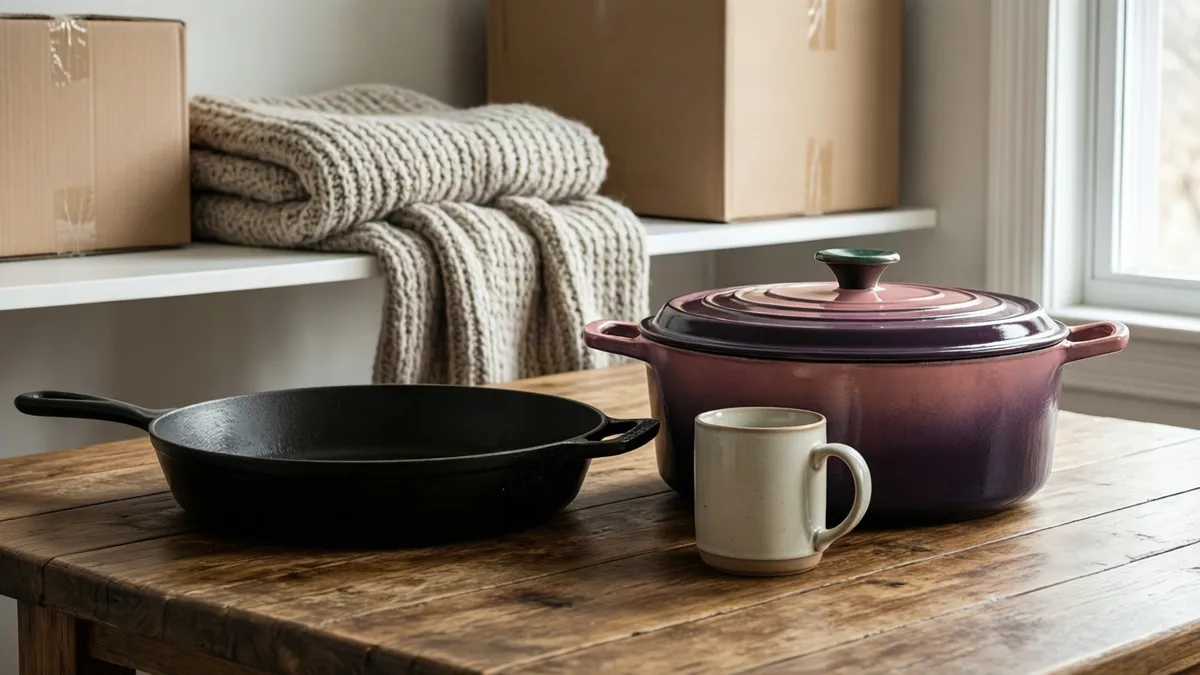
The kitchen is where the duplicate problem is most concrete, so it is where a replacement gift does the most work. A cast-iron skillet, a Dutch oven, or a full knife set is a defensible upgrade only if it clearly outclasses what they each own. Cast iron skillets work well here because the good version is a known quantity: it outlives both of their old pans and needs no cabinet negotiation beyond one hook.
Charcuterie and serving boards are the crowd-pleaser in most guides, and nearly all the pages in our comparison recommend practical kitchen items for exactly this reason. The twist for a move-in: a board engraved with both names personalizes the home, not a person, so it survives the merge.
Mugs deserve a mention and a caution. A pair of matching coffee mugs creates a shared morning ritual, which is the good version of the argument-ending gift. A single novelty mug for one of them is a gift for one person with a shared shelf attached. Pick the set or skip it.
When Personalized Gifts Land, and When They Miss
Personalization is the most recommended category in the guides we compared, and it splits cleanly along one line: does the engraving name the home, or the couple's story?
It works when it personalizes the home they share. An engraved cutting board with the new address, monogrammed towels for the shared bathroom, a return-address stamp. Each marks the household, and each is either in use or in a drawer, not on display awaiting judgment.
It misses when it commemorates the relationship. Custom map jewelry and printed "our first home together" wall art force the couple to decide, permanently, how they present their story to guests. That is a taste decision, and taste decisions are the arguments you are trying to end. Per Pew Research Center, 2019, 69% of Americans say cohabitation is acceptable even if the couple does not plan to marry. Do not assume the occasion is a wedding step. Personalize the address, not the milestone.
Textiles, Candles, and Decor That Skip the Taste Vote
The safe decor shares one property: no permanent placement. That is the whole test.
Textiles are the strongest lane. 7 of the 9 guides we compared recommend cozy textiles for move-ins, and the reason is structural. A chunky throw blanket can live on whichever couch survives the merge, move to the bed, or get folded into a closet without anyone declaring it part of the room. Towels and slippers work the same way: used up, replaced, never defended.
Candles and scent are safe with one boundary. A candle set makes a new place smell lived-in and disappears when it burns down. The boundary is intensity: overly scented items show up on the what-to-avoid lists, because one half may hate the smell and now has to say so. Pick mild, pick consumable, and skip anything that needs a wick schedule.
Wall art, framed prints, and sconces fail the test. They require both halves to agree on a look and a location. Low-maintenance plants are the borderline case: a pothos plant needs a spot but not a taste ruling, which is why it keeps passing.
Hosting Gifts for the First Dinner Party
The first dinner party in a new place is the couple's first shared social event, and it is a gift opportunity that requires no taste agreement. The test is simple: does the item get used when people visit, regardless of how the room is styled?
Serving platters, a decanter, a better cheese knife set, and board games all pass. Each comes out when guests arrive and goes back in a cabinet, so it never has to match the decor. 6 of the 9 guides in our comparison cover hosting gifts, and the useful ones treat the item as equipment, not as styling.
The caveat is the bar cart. Guides list it constantly, but a bar cart is furniture: it demands a footprint, a styling decision, and a liquor budget. In a small rental it is the argument, not the answer. A serving tray that makes any surface a bar is the version that clears the test.
Experiences and Subscriptions When Stuff Is the Wrong Answer
Some couples move with almost nothing and want it that way. For them, and for renters with no storage, the gift should be time or food rather than an object.
State the logistics before the romance, because the logistics are the gift. An experience works only if you can answer four things. When does it expire, how far is it, how far out must they book, and can both of them be free? A class one of them attends alone is a gift for one person wearing a couple's wrapping. A cooking class experience fails more often on scheduling than on interest, so a broadly bookable option beats a fixed-date one.
Subscriptions split the same way. A coffee or meal-kit subscription is consumable and settles a daily negotiation, so it fits the thesis. A decor subscription box sends objects that need homes, which is the opposite of the point. For a couple whose real constraint is clutter, our guide to gifts for couples who have everything makes the same call: go consumable.
No Party? Group Gifts, Registries, and the Card
Many couples never host a housewarming. You get a text, a photo of a new key, and no registry. Here is how to handle the three logistics questions.
Group gift: use a dedicated pooling platform or a shared payment thread, and spend the total on one upgrade they named rather than five small items. Platforms charge a small per-contribution card fee, so check the pricing page before you commit. One good thing beats several anonymous ones.
Registries: few couples make one for a move-in, which means duplicate risk is yours to manage. If you are close enough, ask directly what is still on the wishlist. If not, buy the replacement category and include a gift receipt. Our guide to useful gifts for couples applies the same household test.
Card message, our suggested version — fill in the brackets:
"Welcome to [address or neighborhood]. May the [item they argued about] dispute be settled in your favor. We're glad you two are around the corner from [a place they'll go together]."
Keep the card about the home and the near future. Nothing about the relationship, their plans, or how long it took.
Gifts Most Likely to Be Returned, and What to Give Instead
Across the pages we analyzed, prices for this gifting occasion run roughly $18 to $190, with a median around $58, in our comparison of the top guides. That range is our computation from 414 price mentions, not a sourced statistic. The pattern that matters more than price is which categories survive the merge and which do not.
| Likely-to-sit gift | What to give instead | Why that ends the argument |
|---|---|---|
| Wall art or framed print | A quality throw or towel set | Textiles need no placement decision, so nobody has to defend them |
| Bar cart | Serving platter or tray | Equipment comes out for guests and hides afterward; a cart is furniture |
| Relationship keepsake | Address-engraved board | Marks the household, not the couple's story, so no joint display vote |
| One-half novelty mug | A matched set of mugs | A set serves both halves; a single mug serves one person |
| Scented candle (strong) | Mild candle or hand soap set | Consumable and mild; nobody declares a permanent smell |
Our take: After weighing the categories, our call is this. If the couple owns a duplicate of anything, buy the best version of it. Let yours win the argument for them. If they are minimalists or renters, buy the consumable or the experience with logistics attached. Reserve personalization for the address on an object they will use up. The decorative keepsake is the one gift that converts your goodwill into a joint taste decision, and we think that is the single most returnable gift on this list.
Housewarming Gift Questions People Actually Search
What are the best gifts for a couple renting their first apartment rather than buying?
Prioritize no-installation items: textiles, cookware, consumables, and experiences. Renters cannot mount shelves or change fixtures, so anything requiring a drill or a permanent hook is out. Weight matters too, since they may move again within a year.
What should I write in a housewarming card?
Name the home, not the relationship. Wish them good mornings in the kitchen, quiet evenings, or a short commute, and add one specific detail about the place, like the balcony or the neighborhood. Avoid phrasing that assumes marriage, a mortgage, or next steps.
How do I coordinate a group gift without it feeling impersonal?
Have one person propose a single upgrade the couple mentioned wanting and collect a fixed amount. Then, have one person write the card with a specific line for each contributor to approve. The personal feeling comes from specificity, not from splitting the cost across many items.
What works for minimalist couples with very limited space?
Consumables and subscriptions: good coffee, olive oil, a meal-kit run, or a meal out you book and pay for. The boundary is expiry, so choose options with at least a year of booking flexibility and skip anything that ships as a physical object each month.
Are subscription boxes a good long-term housewarming gift?
They can be, for three to six months rather than twelve. A short run gives the couple a repeated ritual without a long-term commitment, and it ends cleanly if it does not fit. One-time practical gifts age better for anyone whose tastes are still settling.
Mara Ellison writes buying guides, not reviews; nothing here was tested by us.
Sources
- Pew Research Center — "Key findings on marriage and cohabitation in the U.S." (https://www.pewresearch.org/short-reads/2019/11/06/key-findings-on-marriage-and-cohabitation-in-the-u-s/) Retrieved 2026-09-15.
- Federal Trade Commission — "Gift Cards" (https://www.ftc.gov/news-events/topics/truth-advertising/gift-cards) Retrieved 2026-09-15.
- Federal Trade Commission — "Guides Concerning the Use of Endorsements and Testimonials in Advertising" (https://www.ftc.gov/legal-library/browse/federal-register-notices/guides-concerning-use-endorsements-testimonials-advertising) Retrieved 2026-09-15.